
by: Rick Thelen
My family’s farmland northwest of Lansing, Michigan is being seized by eminent domain for ITC (International Transmission Company) for 345-kilovolt transmission lines. ITC only pays for an easement of 200 feet along the length of the line even though on my farm the lines impact entire fields, two houses, and many farm buildings. Our easement offer is only for 15 acres even though the fields with the proposed lines are 140 acres. An 80-acre field by my house is being sliced at a diagonal like a sandwich and one pole will be right in the middle of the field. A 66-acre field by my parent’s house is being sliced in half and the line will be close to the house and buildings. In total there will be at least four poles in the two fields.
Although we are allowed to continue farming under the lines and around the poles, it severely limits what we can do with our land. Rather than placing the lines along ditches and existing fence rows or property boundaries, ITC’s poles and lines are in the middle of fields and will obstruct our tractors, drones, irrigation, buildings, and other future plans. No trees can be planted in the easement and most people would not want any houses or buildings anywhere near the lines. 345-kilovolt lines emit a constant humming noise and potentially cause dangerous EMF levels and stray voltage. They are required by law to be further away from dairy cows than humans. The lines and poles also ruin the beauty of our rural sunrises and sunsets.
Gratiot County, MI, north of our county is already full of wind turbines and there are many solar panels around the state too. Many in those counties regret selling land and allowing wind and solar projects. Often the landowners realize the money received was not worth it. Many contracts are only fixed amounts that do not increase over time and do not include cost-of-living adjustments (COLAs), so each year inflation has greatly eroded the amount received.
Clinton County, MI, where we reside, has greatly restricted wind turbines and solar panels with zoning. However, the zoning of transmission lines has shifted from local citizens to a governor appointed three-person panel at the Michigan Public Service Commission (MPSC). The MPSC usually just rubber stamps everything from ITC and other utility companies. The project impacting our farm is the Nelson Road-Oneida route. Our farm is on what was originally the alternate route but people on the primary route lawyered up early and were able to get the line bounced to the alternate route. Once the alternate route was chosen there was nothing we could do to avoid the lines. One farmer on our route lost his case at the Court of Appeals and his lawyer advised to him that they would not win at the Michigan Supreme Court.
In Michigan, Public Act 235, passed in 2023, requires electric providers to achieve a 50-percent renewable energy portfolio by 2030 and 60 percent by 2035. This means more solar and wind projects are being proposed all over the state. Power generation from natural gas, coal, nuclear, and hydroelectric dams used to occur near population centers, but now large swaths of rural land are being used for wind and solar power generation. In particular, solar is not effective here because the state of Michigan itself ranks as the seventh cloudiest state in the U.S., primarily due to lake-effect cloud formation from the Great Lakes. The renewable energy generation within Michigan is not enough, so energy will also be needed from other states. There are transmission line battles all over the country and eminent domain is often used in other states, too.
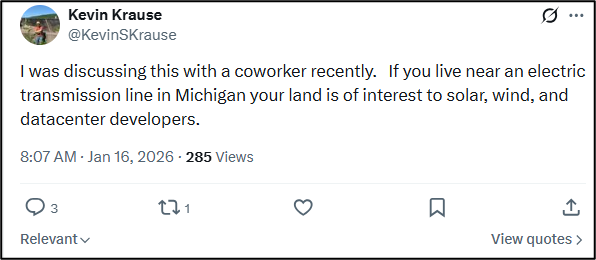
While more transmission lines may be needed to stabilize the power grid, the government’s push for wind and solar generation and datacenters is largely the reason why Michigan is moving so rapidly to seize private land for transmission lines. As stated by one MPSC employee, “If you live near an electric transmission line in Michigan your land is of interest to solar, wind, and datacenter developers.” My family and most of my neighbors do not want our property used for solar, wind, and datacenters. Agreements should be voluntary and we should not be forced to sell our land.
Why does the State of Michigan allow eminent domain to be used when it already owns plenty of land that can be used for transmission lines or other projects central planners deem necessary? For example, North of my farm the Nelson Road-Oneida route shifts around the Maple River State Game Area. Instead of building on that land, the line is being run for additional miles through private property. Why is private property less valued than government-owned land? If transmission lines are considered a public good then they should be placed on public (government-owned) land. There is also a proposed Copperton transmission line project north of my route where federal land could be used instead of private land. Eminent domain should not be allowed for transmission lines!
The house I live in, and a significant portion of our farm, has been in the family for almost 100 years. My wife and I are raising our eight children in the same house in which my grandparents raised their nine children. Our children and their offspring will no longer be able to build houses on much of our property. So far, the offers for the easement are less than the market farmland rate even though we have plans for houses for our children and property for residential use is worth significantly more than farmland.
ITC has little regard for farmers, private property, houses, or anything in their way. Many neighbors have houses that will be just outside of the easement area and many woods are being cleared for the lines. The woods near me on the route have bald eagle nests, bee hives, and many other desired creatures. The landscape will never be the same after fields and woods are replaced with concrete, poles, and lines.
ITC has already taken us to court to allow soil boring, which may damage our underground field tiles used to drain water from our fields. Often the damage is not obvious until dirt gets into the tile and reduces drainage or sink holes form in the field. A neighbor provided maps of his drainage tiles and the maps were not even referenced when his soil boring was completed.
Many people on our route have hired attorneys to maximize their settlements. Such attorneys are often entitled to a third of any increase from the first offer. One attorney has nearly 200 clients on our route. My family and I have chosen to do everything we can to delay or stop the eminent domain seizure of our land. We do not want the money for the easements and we do not want the transmission lines on our property. We already have many other utilities, like distribution power lines, natural gas line, fiber internet, and other telecommunication lines. In the past those utilities have also caused significant damages to our crops and underground drainage tiles.
For others being impacted by transmission line eminent domain projects:
- Do everything you can to delay or stop the project.
- Do not sign or grant anything and force the aggressor to use the courts to proceed.
- If forced to sign or comply by courts, then review and modify contracts. Essentially almost all contracts will require modification, even early access agreements. An attorney may be needed to modify contracts.
- Late in the process, to maximize your settlement, an attorney might be needed. Do not retain an attorney too early for that purpose because their incentive is to keep the project moving along so they receive payment.
- If all property owners did this, the transmission line routes would take many more years to complete.
There is nothing “green” or “renewable” about seizing prime land with eminent domain. Utility companies should enter voluntary agreements with property owners. Preferred routes should be existing easements or existing government-owned land. Also, utilities should be required by law to work with each other to reduce the need for so many easements. If utilities are not allowed to use eminent domain, the voluntary agreements would naturally happen between companies and landowners.
In Michigan, there are some legislators who are working to make eminent domain more difficult to invoke. On August 26, Michigan House Bill (HB) 5940 passed unanimously (98-0) with bipartisan support. It is now waiting in the Senate committee on Energy and Environment. HB 5940 would modernize utility line standards and allow aboveground transmission lines in limited-access highway rights-of-way. Similar legislation is being proposed in other states too. The legislation might too late for our farm’s situation but I would be extremely grateful if fewer property owners have their land taken by force.
Rick’s family has farmed in America now for over seven generations, Many of his ancestors left Europe and other places for America due to government overreach and lack of opportunities. Rick is the vice-chair of the Capital (Lansing) Area LP and lifetime member of both the Michigan and National LP.
Follow Rick on X at: https://x.com/rickathelen